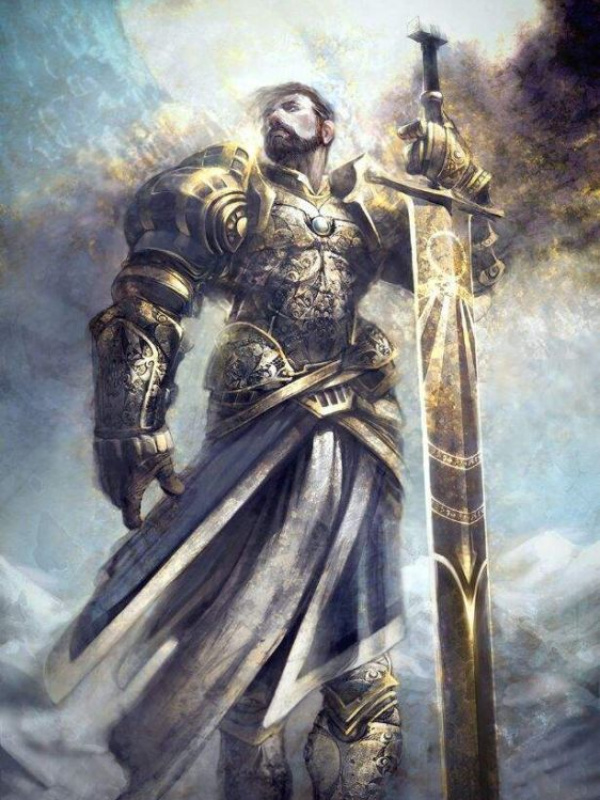
Viking Invasion-Chapter 104 – The Duke (III)
At that moment, Lambert appeared perfectly calm.
"You misunderstand, my lord," he said smoothly. "His Majesty merely admires the bond you and Ragnar have shared for twenty years. He would never seek to destroy so precious a friendship. He only wishes you to govern the northern coast—and, incidentally, to quell the rebellions in Aquitaine and Brittany."
Through the window, Gunnar gazed eastward across rolling meadows and farmlands. He drew in a deep breath. Beneath the salt-stung air lingered a subtler fragrance—the rich scent of fertile soil.
In all his years of wandering, he had known only two lands to match such bounty: the black earth of the middle Dnieper, and the fields of West Francia. Britain came third; the North, last of all.
If only...
No—there were no ifs.
At length, he refused. 𝓯𝙧𝙚𝒆𝙬𝙚𝒃𝙣𝙤𝒗𝓮𝓵.𝙘𝙤𝙢
"Sigh... I am the Earl of Cambridge," he said quietly. "Britain is my place. I am not meant to rule this land."
Lambert burst out laughing, sensing the hesitation beneath the words.
"My lord, you worry too much. In this age, it is common for nobles to hold lands in distant realms. Leonard and Ulf, for instance—both keep estates in Britain and in their Swedish homeland.
"With your valor and renown, claiming Normandy is only natural. The Earl of Cambridge in Britain, the Count of Normandy in Francia—there’s no conflict there. But if you truly refuse, I shall offer it to another—Nils, perhaps, or Orm."
Gunnar snorted. "Them? To tame those northern raiders? Only Rurik, Ivar, or I could manage that."
The words came unbidden, and after uttering them he fell into a long silence. At last, he spoke again—but this time he named a list of impossible terms.
He would marry the Frankish king’s niece, Vivian, and become a vassal of Francia. But he must be granted greater independence than any ordinary count. His title must be hereditary—dux Normanniae, Duke of Normandy—and he would rule his lands by Viking custom.
And should war ever break out between Francia and Britain, he would remain strictly neutral.
To his surprise, Lambert agreed to every condition—save one.
"In return," the minister said softly, "you and your men must embrace the faith of Rome."
"Give me time," Gunnar replied after a pause. "I’ll do my best to persuade them."
Lambert inclined his head. "Very well, Your Grace. May our friendship endure."
When the soldiers learned their lord intended to convert, nearly half deserted him the next day, sailing home to Britain with the ransom silver. Only a quarter declared themselves willing to change faith; the rest wavered, waiting to see which way the wind would blow.
With a heavy heart, Gunnar boarded ship with four hundred loyal Northmen and set sail for Île de la Cité.
At the Paris dock, the King and Queen, together with their ministers, awaited his arrival. Among the crowd stood a pale, dark-haired girl whose reddened eyes betrayed recent tears.
She was Princess Vivian—granddaughter of Charlemagne’s line, and Gunnar’s betrothed.
Gunnar stared at her for half a minute, until she trembled and burst into tears. He merely shook his head and strode toward the King.
"When will the investiture and wedding take place?"
Charles smiled warmly, though his tone left no room for debate.
"First, the baptism. Then, the ceremony."
"As you wish," Gunnar replied.
As priests chanted their Latin verses, Gunnar and half his men waded into the shallows and were baptized, proclaiming their conversion to the Roman Church.
When he returned to shore, he tossed his wet golden hair, scattering droplets onto the courtiers’ fine robes. They recoiled in annoyance; Gunnar ignored them.
Charles drew his sword and, in the name of the crown, proclaimed him Duke of Normandy.
The ceremony complete, the crowd streamed toward the royal palace at the island’s center. The great hall had been prepared for the wedding—lavishly decorated, tables overflowing with venison, fowl, and wine. It far surpassed any feast Gunnar had attended in Britain.
Seated at the long table, he seized a roast haunch of deer and tore at it with his teeth, indifferent to the stares of the Frankish nobles.
"The venison’s good," he said through a mouthful. "What did you season it with?"
Lambert replied, "Thyme, pepper, and a touch of truffle from northern Italy."
"Fancy," Gunnar grunted. "Compared to you, the Angles can’t cook worth a damn."
As the feast wore on and laughter filled the hall, Charles suddenly clapped his hands. From a side corridor, a guard emerged bearing a long sword upon a cushion.
"My lord," said Charles, raising his goblet toward Gunnar, "I heard that in the battle half a year ago, you broke two blades in combat. Now that you are a duke, you deserve a weapon worthy of your station."
He gestured, and the guard presented the sword. Gunnar took it and drew the blade.
"A fine piece," he murmured.
It had a cruciform guard and a long, slender edge etched with elegant Latin script. Under the light of a hundred candles, a diamond set in the hilt flashed brilliantly, dazzling his eyes.
He swung it a few times; the balance was perfect, the motion smooth as water.
"What does the inscription mean?" he asked.
Lambert leaned close and read aloud: "Per aspera ad astra—’Through hardships, to the stars.’ What name will you give it, my lord?"
Gunnar scratched his hair and set the sword before Vivian. "You name it."
The princess, gazing at the diamond’s light, forgot her fear for a moment. Her fingers brushed the hilt.
"Dawn," she whispered.
After the wedding, Gunnar lingered in Paris for three days, then set out with his bride, his soldiers, and a retinue of servants for his new castle at Caen.
The fortress, rebuilt from an old Roman stronghold, rose ten meters high and spread across a broad field—far grander than his cramped wooden keep at Cambridge.
Once he had settled his household, Gunnar left Vivian and the servants behind, and led his men aboard their longships. Guided by local fishermen, they sailed along the coast for a full day until a shadowed outline appeared on the horizon.
"So that’s Jersey, one of the Channel Islands?"
The fisherman, trembling, nodded. "Yes, my lord. In July, a man named Young Erik raided the coast with his fleet. Before returning to Norway, he left a small garrison on the islands—to repair the docks and barracks, and to use them as outposts for future raids on West Francia."
Hearing the name, Gunnar spat. "That wretch dares trespass on my waters?"
He ordered the ships to anchor in a hidden cove for the night. At dawn, wrapped in heavy fog, the fleet moved silently toward the island’s southwest shore.
The pirates had not yet fortified their camp, and Gunnar’s four hundred men surged into their settlement like ghosts, capturing them in their sleep without a single casualty.
"Those who surrender shall live!"
At his shout, more than two hundred raiders stumbled from their huts, faces drawn with despair, and crouched in the open field awaiting judgment.
After half a minute, one of them recognized him. A murmur rippled through the crowd, rising into angry cries. None could understand why Gunnar the Northman would turn his sword against his own kind.